
Women's Huron Valley Releases
Women's Huron Valley Correctional Facility is a Michigan state prison. It is not the women's unit of the Washtenaw County Jail. A person leaving secure confinement at WHV may begin parole in the community, transfer to another MDOC placement, enter an approved program, or reach maximum discharge. The word “release” must be read with the status and destination. Physical departure from prison does not always end the sentence.
Parole is the most important distinction. Under Michigan law, a parolee is outside prison but remains in MDOC legal custody and under conditions. OTIS should show Current Status as Parolee and may show an Assigned Location for the supervising office. Maximum discharge or later completion of parole ends MDOC jurisdiction and can produce a Discharged status. A facility transfer, by contrast, does not return the person to the community.
Confirm Women's Huron Valley Release
The Michigan OTIS search is the main public route. It covers current and former MDOC prisoners, parolees, MDOC probationers, and discharged people within its public window. Search by MDOC number whenever possible because names can match. A no-result does not prove that no state record exists, especially in an older or protected case.
- Enter the MDOC number, or use a specific first and last name.
- Select All when the status is unknown. Try Parolees for a person believed to have left prison under supervision.
- Use Discharged when the question is whether MDOC jurisdiction has ended.
- Open the profile and compare date of birth, aliases, physical details, sentencing county, court file, and MDOC number.
- Read Current Status, Assigned Location, Earliest Release Date, Maximum Discharge Date or Discharge Date, and each sentence row.
- Confirm a significant result with MDOC, the supervising office, MI-VINE, or the court record.
OTIS data can lag. A status header and a sentence row can also show different dates when sentences run together or one sentence has ended while another remains active. Assigned Location is an office or correctional assignment, not a home address. An absconder label means the person is not reporting as required. It does not provide a current location.
An individual OTIS profile can include aliases, the MDOC number, a state identification number, a photograph and image date, physical descriptors, sentence dates, the offense and Michigan Compiled Laws citation, sentencing county, court file number, minimum and maximum terms, and a sentence-level discharge reason. These fields help confirm that the profile belongs to the right person and explain which sentence produced the status. They do not form a full criminal history. A photograph is an MDOC corrections image, not proof of current confinement or the exact time someone left WHV. When a court-derived field appears wrong, correction begins with the sentencing court. A supervision entry should be addressed through the assigned parole or probation office.
Note: The county jail search path is useful only for a separate WCSO booking, not for release from this state prison.
Women's Huron Valley Contact
The facility's main contact can route questions about current institutional operations. Public release and discharge documents are held through MDOC channels. The facility page does not promise that staff will provide private details by phone, and the research did not verify public release-desk hours.
Women's Huron Valley Correctional Facility
3201 Bemis Road
Ypsilanti, MI 48197-0911
734-572-9900
Washtenaw County Parole Office
3201 Bemis Road
Ypsilanti, MI 48197-0911
734-434-1486
The parole office is located on the same campus, but it serves a different function. It addresses state community supervision after release. The prison manages confinement, while the parole office manages an assigned person's community supervision. Call the office shown in OTIS when a profile needs supervision routing.
Women's Huron Valley Facility
MDOC operates Women's Huron Valley as Michigan's only prison for women. It holds people across all security levels and carries statewide roles that include female reception, Special Alternative Incarceration functions, treatment, and reentry work. Those roles make the campus more than a local prison serving Washtenaw residents. The state system controls admission, movement, parole processing, and discharge.
The official capacity is a facility figure, not a count of current residents or releases. Reception work also means some people may appear at WHV while being assessed for a later state placement. A movement away from the campus is not automatically parole or discharge. OTIS status and MDOC records establish what occurred.
Why WHV Release Is Statewide
WHV combines the state's female reception function, all security levels, Special Alternative Incarceration duties, reentry programming, and Washtenaw parole offices on one Ypsilanti campus. That distinctive mix can make a local search misleading. The prison sits in Washtenaw County, but the people confined there can come from courts across Michigan. Their records remain under MDOC jurisdiction.
The official Women's Huron Valley facility page documents those roles and is the source for the facility image below.
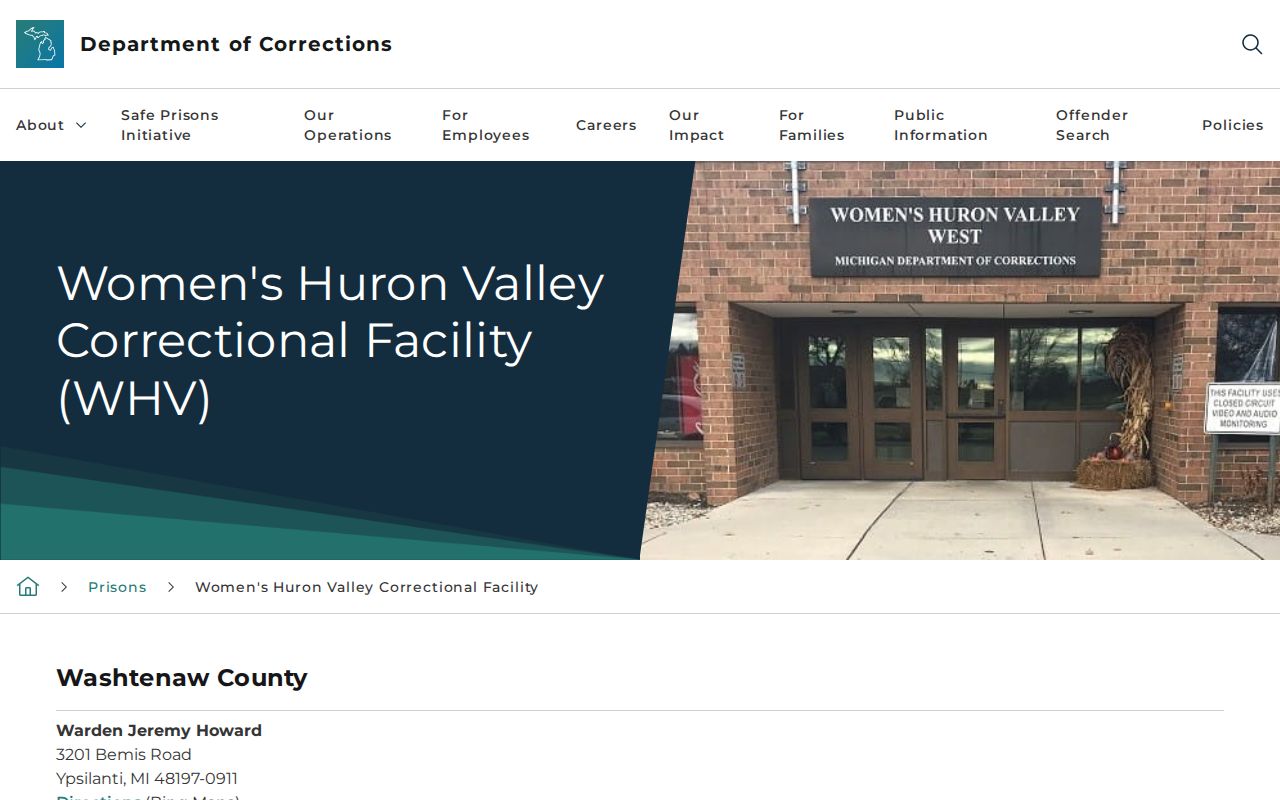
The statewide role is why a woman leaving WHV must be followed through OTIS, MI-VINE, the Michigan Parole Board process, and MDOC records rather than WCSO.
Women's Huron Valley Release Dates
Michigan uses indeterminate sentencing for most prison cases. OTIS displays an Earliest Release Date and a Maximum Discharge Date rather than one guaranteed departure date. The earliest date marks the point when Parole Board jurisdiction can begin under the sentence and governing rules. The maximum date is the potential outside sentence date. A parole decision and release processing determine what happens between them.
For covered truth-in-sentencing cases, the full judicial minimum must be served before parole consideration. Michigan does not use a universal 85% formula. Older cases can involve historical credit rules based on the offense date. Consecutive sentences, holds, sentence corrections, misconduct, parole denial or deferral, and placement planning can all affect the practical timeline.
MDOC says parole review begins about six months before eligibility or reconsideration, and at least 28 days is needed between a Board release decision and physical release for processing. A favorable decision, the earliest date, and actual departure can therefore be three different dates. The Washtenaw County inmate release date resource explains those date labels in more depth.
WHV Parole and Discharge
A positive Michigan Parole Board decision does not itself prove that a person walked out that day. The Parole Release Unit documents the parole date, term, special conditions, and required notices. Placement and processing must be completed. When physical release occurs, the person remains in MDOC legal custody during parole.
- Prisoner
- The person remains confined in an MDOC institution or placement.
- Parolee
- The person has left prison under MDOC community supervision.
- Discharged
- MDOC sentence and supervision jurisdiction have ended.
- Assigned Location
- The office or correctional assignment responsible for the case, not a residence.
Washtenaw's state parole office operates from the WHV campus, while the MDOC probation office is at 101 East Huron Street in Ann Arbor. These offices are not interchangeable. A person released on parole should be routed through the assigned parole location. Someone on MDOC felony probation may never have served at WHV.
WHV Release Notifications
MI-VINE through VINELink provides general release notification for MDOC offenders. Search for the specific person, compare the agency and offender number, and register only from the matched record. Phone, text, and email options may be available. Phone registration uses a four-digit PIN to acknowledge a call.
VINE is an alert system, not the complete discharge record. A feed can lag, and a transfer may generate a custody event that needs context. After an alert, read OTIS and contact MDOC when the release type or destination matters. Keep the MDOC number because it is more reliable than a name alone.
Request WHV Release Records
When OTIS does not supply enough detail, use the MDOC FOIA process. Identify the person by full name and MDOC number. Name the existing record sought, such as a discharge certificate, parole order, parole date and status record, or time-computation sheet. A focused request avoids asking staff to create a new explanation.
MDOC FOIA Coordinator
P.O. Box 30003
Lansing, MI 48909
517-335-4194
MDOC-FOIA@michigan.gov
Fax: 517-335-4193
MDOC identifies separate records contacts for current and past prisoners. Past-prisoner records up to six years after release may route through the past-prisoner channel, while older records can require retention staff or the Archives of Michigan. OTIS public visibility normally ends three years after the most recent discharge unless a set-aside or another legal rule removes the profile sooner.
Note: A public OTIS no-result after discharge is not proof that MDOC never held a responsive release or sentence record.