
Washtenaw Parole and Probation Compared
Parole and probation can both place a person in the community under rules, but the legal path is different. Michigan parole follows release from a state prison term. The person has left the prison setting yet remains in the legal custody of the Michigan Department of Corrections under MCL 791.238. State felony probation is a court sentence supervised by MDOC and may occur without a prison term. Washtenaw County also has district-court probation for local matters. That local track is not the same as MDOC probation.
Community Corrections adds a third source of confusion. Its pretrial programs may include court-referred testing, intensive treatment supervision, or electronic monitoring after a person leaves the county jail. Those controls do not prove that the person is on parole, that a sentence has ended, or that MDOC has jurisdiction. The order and supervising agency determine the correct record.
| Track | How it begins | Best verification source |
|---|---|---|
| Michigan parole | Physical release from state prison under MDOC supervision | OTIS Parolees status and the assigned MDOC office |
| MDOC felony probation | A felony court order placing the person under state supervision | OTIS Probationers status and the assigned MDOC office |
| 14A District Court probation | A local district-court sentence | The 14A District Court probation office and court case |
| Community Corrections | A pretrial or court-referred community control | The court order and Washtenaw Community Corrections |
- Parole
- Supervised community placement after release from a state prison sentence.
- Probation
- Court-ordered supervision in the community, which may occur without a prison term.
- Discharge
- The end of the supervising agency's jurisdiction, not merely release from a building.
- Assigned Location
- The MDOC office responsible for supervision, not the person's home address.
Check Washtenaw Post-Release Supervision
The public starting point for Michigan parole and felony probation is the MDOC Offender Tracking Information System, known as OTIS. It covers state prisoners, parolees, MDOC probationers, discharged people within its public window, and listed absconders. It does not cover every person who left Washtenaw County Jail. A jail-only case may belong in the county court record, MI-VINE, or a WCSO release record instead.
- Search by MDOC number when known. Otherwise use a specific first and last name and compare the resulting identifiers.
- Select Parolees for a person released from state prison, Probationers for state felony probation, or All if the supervision type is not clear.
- Open the matching profile. Compare date of birth, MDOC number, sentencing county, offense, and court file number before relying on it.
- Read Current Status and Assigned Location together. The location is the supervising office and may be the last office shown for an absconder.
- If the result says Discharged, read the discharge date and sentence rows. That status means MDOC jurisdiction ended, not just that prison custody ended.
- Confirm an unclear entry with the office identified in OTIS. Court-derived errors should be raised with the sentencing court.
An OTIS miss is not proof that no supervision exists. A person may be on 14A District Court probation, under a Community Corrections pretrial order, outside the public OTIS retention window, or identified under different data. For a named county-jail release, the broader Washtenaw County released-inmate search path helps separate the county, state, and federal systems.
Note: OTIS keeps discharged profiles public for a limited period, so older supervision must be checked through court or agency records.
Washtenaw Supervision Offices Are Split
Washtenaw County is in MDOC Metropolitan Territory, Region 9. State parole and felony probation do not operate from one shared public counter. The official directory places the parole office at the Women's Huron Valley Correctional Facility campus in Ypsilanti. It places the probation office in downtown Ann Arbor. This split is why the Assigned Location field matters. Contact the office tied to the record, not whichever address is closer.
Washtenaw County Parole Office
3201 Bemis Road
Ypsilanti, MI 48197-0911
734-434-1486
Washtenaw County Probation Office
101 East Huron Street
Ann Arbor, MI 48107-8645
734-222-3390
The official MDOC Region 9 directory shows how Washtenaw parole and probation contacts are divided. This captured directory view is useful for routing an inquiry, but it must not be read as a list of homes or current physical locations.
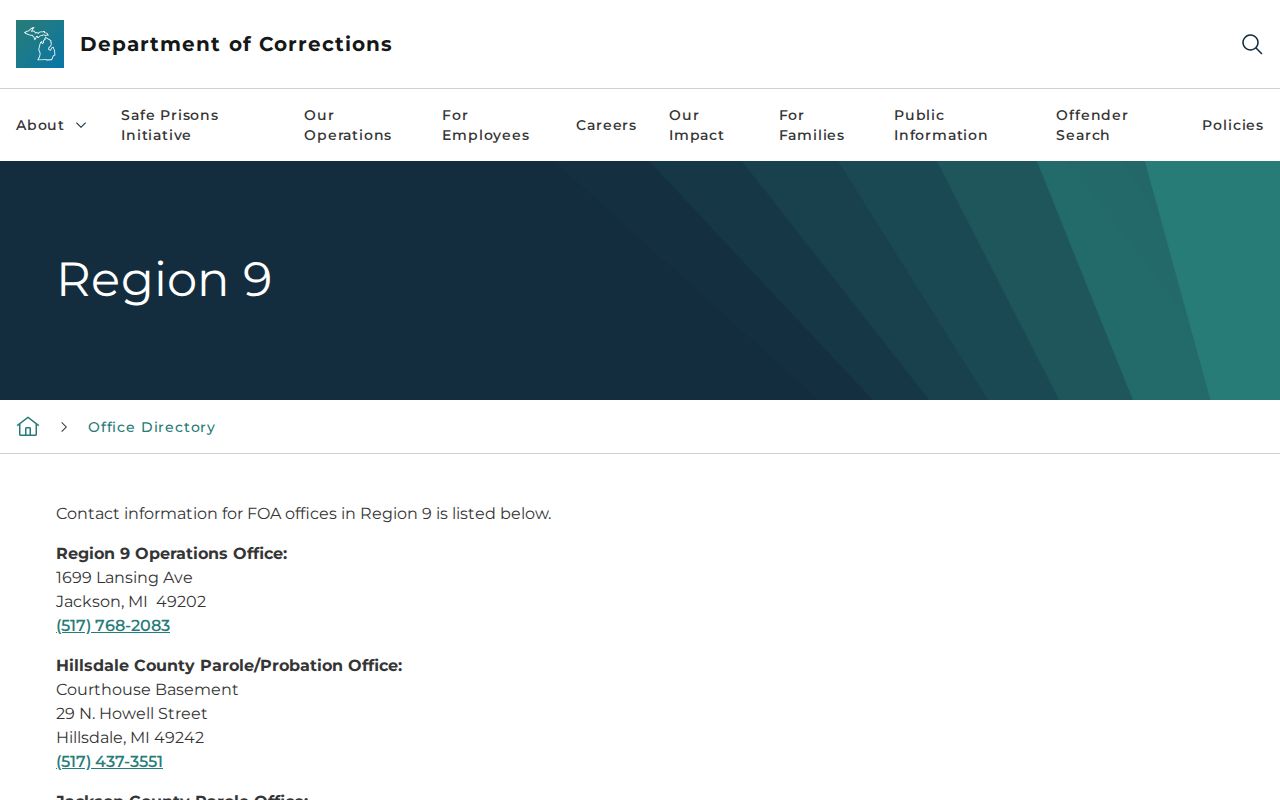
Use the current live directory before calling because an assigned office or published contact can change.
Washtenaw Local Probation Records
A Washtenaw County district-court probation order may never appear under the OTIS Probationers filter. The 14A District Court probation page identifies local offices and resources for district-court cases. At the time of the researched page, 14A-1 was at 4133 Washtenaw Avenue in Ann Arbor, while 14A-2 was at 415 West Michigan Avenue in Ypsilanti. The page placed 14A-3 and 14A-4 temporarily at the Washtenaw Avenue site, so the live court page should be checked before an office visit.
Start with the court case number. The Michigan court record may show the judgment, probation term, violation events, modifications, and discharge entry, subject to record availability. It does not turn local probation into MDOC supervision. Likewise, a tether or DART referral through Community Corrections is a pretrial or court control, not a state parole record. A clear answer names both the judge or court and the agency carrying out the order.
Washtenaw Absconder Status and Violations
Supervision conditions are set by the controlling order and the assigned agency. They can address reporting, approved placement, travel, treatment, testing, contact, and other case-specific duties. A public profile does not necessarily display each rule. The person's written conditions, supervising agent, and court or Parole Board documents are the better sources for the actual terms.
OTIS has separate Parole Absconders and Probation Absconders filters. An absconder is a supervised person whose whereabouts are not known to the agency after a failure to remain in contact or comply with reporting. The label is not a current-address tool. It also should not be treated as proof of a new arrest or a known place. Assigned Location may remain the last office responsible for the case.
MDOC routes location information to law enforcement or its Absconder/Escapee Tip Line at 517-755-0855. Questions about whether a warrant exists or whether a court has ruled on a violation belong with the issuing court or agency. MI-VINE can provide custody-event notice when a participating jail or MDOC reports an event, but it is not a full supervision-condition or warrant database.
Note: A supervision violation can change custody status, yet the court or MDOC record remains the source for the legal outcome.
Washtenaw Release Transition Resources
Washtenaw County places some transition work inside its jail and Community Corrections programs. The CSTS/JPORT discharge-planning service supports continuity for incarcerated people who receive psychotropic medication. The county's jail classes also include transition information on what to expect while on parole or probation. Community Corrections administers local alternatives and controls tied to court referrals.
These resources help explain the path out of custody. They do not verify that release occurred, identify the assigned parole agent, or prove that supervision ended. Custody confirmation still comes from the reporting jail, OTIS, MI-VINE, or the court. Supervision confirmation comes from the order and responsible office. Keeping those two questions apart avoids a common Washtenaw County error: treating participation in a transition program as a legal status.
Washtenaw Property Before Release
Property can be released before the incarcerated person's own departure from Washtenaw County Jail. Under the current WCSO property-release procedure, the person in custody must send a kite to Intake, Transfer and Release naming the person authorized to collect the property. The county specifically says the kite should not be handed to a visiting officer.
This property transaction is not evidence of parole, probation, or release from custody. It is a separate jail service. A historical Washtenaw facility assessment described staff checking identity and eligibility, exchanging property, obtaining signatures, and directing released people through the public lobby, but that older description does not establish a current release time or exit procedure. For status, rely on the agency record rather than a property pickup.
Washtenaw Supervision Discharge Records
Parole ends only when MDOC jurisdiction ends, not when the person first walks out of prison. OTIS uses Parolee for physical prison release with state supervision. It uses Discharged when MDOC jurisdiction has ended and may show a discharge date, inactive sentence, and discharge reason. Michigan law also treats a parolee as remaining in the legal custody of the department during parole.
Probation discharge follows the controlling court and supervision system. A local 14A discharge belongs in the district-court case, while an MDOC felony probation discharge may appear in OTIS during the public window. If the status conflicts with a court entry, note the case number and ask the source that controls the disputed fact. MDOC says court-derived corrections go to the sentencing court, while supervision-related errors go to the supervising office.
A release alert and a discharge record answer different questions. MI-VINE may report a move out of a participating custodial setting. The discharge entry establishes that a particular agency's supervision ended. When both matter, retain the official number and date from each record instead of using the word “released” as a substitute for both events.