
No Washtenaw 24 Hour Feed
The Washtenaw County Sheriff's Office, or WCSO, has no verified public roster or recent-release page. Its current Corrections menu and Incarcerated Individual Information menu provide jail-service topics, but neither menu offers a list of people released today. The plausible former inmate-search address now returns an official Page Not Found response. No WCSO release app was found either. Account and communication tools named on jail-service pages are not custody feeds.
This absence is the first fact to use. There is no public window definition, photo column, refresh cycle, retention period, or exact list URL to quote. It would be inaccurate to display requested record fields as though they came from a live sheriff table. Someone seeking a same-day answer must build it from official event and record channels. That is slower than scanning a feed, but it avoids a false claim about a service WCSO does not provide.
Check Washtenaw Releases Today
Begin with the system tied to the last known custody. The Washtenaw County Jail path applies to a local arrest or local jail sentence. MI-VINE may report a custody event for a participating jail record. A court entry can show the order that led to bond, dismissal, time served, or another change. WCSO holds the jail's actual booking, movement, and release records. OTIS, the Michigan Department of Corrections search, belongs later in the chain only if the person entered MDOC jurisdiction.
- Search the Michigan court case portal by name or case number. Read recent bond, dismissal, sentence, and transfer entries in order.
- Check MI-VINE through VINELink for the same person. Use a booking or offender number when known, and compare the agency and identity details.
- Call WCSO at 734-971-8400. Ask for the jail or records channel that can confirm whether the person remains in WCSO custody.
- Use the WCSO records-request route when a written timestamp or disposition is needed. Name the booking sheet, release sheet, and jail movement or transfer entry.
- If the court shows a state-prison commitment, search MDOC OTIS. Use BOP or ICE instead when the record shows transfer to those authorities.
The Washtenaw County released-inmate search gives the broader named-person path when the last custodian is unclear. A same-day check remains a chain of corroboration, not a substitute public list.
Request Washtenaw Release Fields
WCSO has not exposed the columns of a 24-hour feed. The fields below are therefore items to request from existing booking, release, and jail-movement records. They are not advertised feed fields. A narrow request helps staff identify a record and helps the reader tell community release from agency transfer.
| Requested field | Why it matters |
|---|---|
| Full name, date of birth, booking number | Distinguishes the correct Washtenaw County booking from a similar name. |
| Booking date and time | Defines the custody episode connected to the requested release event. |
| Actual release date and time | Shows when WCSO completed its custody event, if that field exists and is disclosed. |
| Release disposition or authority | May identify bond, time served, dismissal, court order, or another coded basis. |
| Charge and court case | Connects the jail event with the court record that may explain it. |
| Receiving agency or destination | Separates a return to the community from transfer to MDOC, another jail, USMS, or ICE. |
| Hold or detainer status | Shows whether another authority had a claim on custody at departure. |
Ask for an existing code key if the release field uses abbreviations. Michigan FOIA covers existing public records, not a duty to create a new answer. WCSO may redact material or apply an exemption. Its live sheriff FOIA and fee pages control the current submission method and any charge, so an estimate should be requested before costly work begins.
Note: “Released from WCSO” can mark the end of county custody even when another agency immediately receives the person.
How Washtenaw Release Was Processed
A 2003 Washtenaw jail planning assessment offers local history about Intake, Transfer and Release, known as ITR. It described staff checks of identity and eligibility, return of personal clothing and valuables, required signatures, and departure through the public lobby. The process shows why a court order and a gate-out event are not always simultaneous.
The assessment is historical, not a statement of current practice. No current release hour, current exit door, family waiting rule, or book-out procedure was verified. The older document should not be used to predict today's departure time. It does explain why staff must finish administrative steps after a legal release basis exists, and why a just-ordered release may not yet have an official jail timestamp.
Getting Home After Washtenaw Release
The jail is part of the County Service Center on Hogback Road. The published TheRide guide lists Route 66 service in the County Service Center and Hogback area on limited weekday trips. It shows no Sunday service. That is a planning lead, not proof of a dedicated jail-door shuttle or a guaranteed trip at the time someone leaves custody.
Family and friends should confirm the live schedule, the closest safe stop, and the last trip before relying on transit. Release processing has no verified fixed time, so plans need room for delay. A court order may arrive before ITR work is complete. A transfer to another authority also changes the destination entirely. The release record should be checked before anyone assumes the person will exit to the Hogback area.
Washtenaw Bond Release Conditions
Bond can end physical jail custody while the criminal case stays open. Washtenaw's official bonding information explains its accounting for a 10% bond. When that form of bond is posted, the court retains part of the amount posted and the balance can be released to the bonder when the case ends or the court orders it sooner. The bond entry should be read with the jail release event.
Community rules may also continue. The Washtenaw Pre-Trial Program describes court-referred DART testing, supervised intensive treatment through Dawn Farm, and electronic monitoring. These are community controls, not proof of sentence completion or MDOC discharge. A person can be released from jail today and still have court dates, testing, monitoring, or other conditions. The court order and program record explain that ongoing legal track.
Washtenaw Release Roster Is Absent
The county's distinctive data issue is not a short retention rule. It is the lack of a verified public roster in the first place. The current official menus expose services for people in custody, while the old-looking search route fails. Therefore no sound before-and-after roster comparison exists for a Washtenaw County release. No public photo indicator, update cadence, or 24-hour archive can be inferred.
The official former path can be seen in the WCSO inmate-search response captured below.
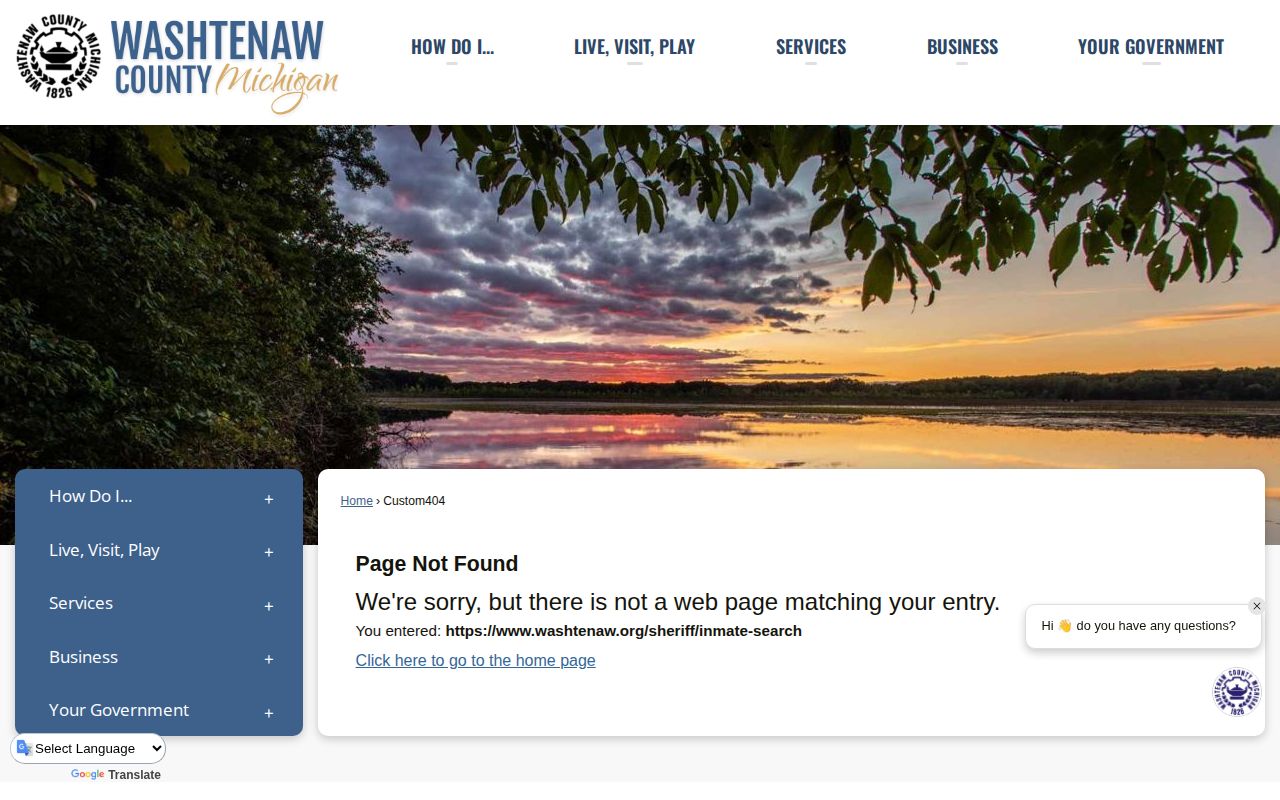
The image documents the current absence of that web route. It does not prove that WCSO lacks internal booking data, and it must not be replaced with an unofficial roster.
Washtenaw Release or Transfer
A court order for bond, dismissal, or time served may lead back to the community. A commitment order may instead move the person into MDOC custody. Federal and immigration authorities have their own systems. The key question is which agency had legal custody after WCSO's event, not whether the county stopped holding the person.
- Physical release
- The person leaves a particular facility, but a case or supervision may continue.
- Transfer
- One agency ends possession because another agency receives the person.
- Parole
- A state prisoner leaves prison while remaining under MDOC legal custody and supervision.
- Discharge
- The responsible corrections agency ends its legal jurisdiction or supervision.
MI-VINE can help with a participating custody event. OTIS can show Parolee or Discharged status for an MDOC case, but it does not cover an ordinary county-jail-only stay. The BOP locator addresses federal imprisonment, and ICE ODLS addresses immigration detention. Each result should be read only within that system's scope.
Note: Use the Released Last 72 Hours process for a wider date range, especially when a same-day event crosses midnight.