
No Washtenaw 72 Hour List
The Washtenaw County Sheriff's Office has no verified public rolling 72-hour release view. The WCSO Corrections page and official jail-information menu present service links, but not a current roster or three-day archive. The former-looking sheriff inmate-search path is now an official error page. No WCSO jail app with releases or mugshots was verified.
That means the county publishes no confirmed three-day window definition, refresh schedule, photo field, or retention rule. There is also no sound way to count people by scraping an unofficial roster. Private sources may display stale data, use unclear timestamps, or confuse booking activity with release. The legitimate task is to ask whether WCSO keeps an existing date-bounded record and, where needed, examine specific cases through official systems.
Request Washtenaw Three-Day Releases
A three-day inquiry differs from a same-day check. It seeks a defined interval, not just the status of one named person. Through the WCSO records-request hub, ask for an existing release log or jail-movement record covering the start and end date and time. Do not state that such a list must exist. Michigan FOIA gives access to existing, nonexempt public records and does not require the sheriff to create a new report.
- Set the interval with both dates and times. Include the correct year and time zone so the boundary is clear.
- Ask for an existing release log, release report, or jail-movement record for that interval, if maintained and disclosable.
- Request fields that distinguish release from transfer, including the disposition or authority and receiving agency.
- Ask for electronic delivery and an estimate before fees exceed a chosen amount. Check the live sheriff FOIA instructions.
- If no aggregate record exists, investigate the relevant individuals through court, MI-VINE, and a targeted WCSO booking and release request.
WCSO generally must give the kind of response described by Michigan FOIA within five business days, such as grant, denial, partial grant, or a permissible extension notice. That response period is not a promise that all records will be produced within five days. Redaction, exemptions, and lawful fees may apply.
Washtenaw 72 Hour Record Fields
No online feed schema exists to reproduce. The table identifies requested fields for an existing WCSO release or movement record. These columns should never be labeled as a public 72-hour feed display. Their purpose is to anchor a precise request and reveal whether an apparent release was a transfer.
| Requested field | Use in a three-day review |
|---|---|
| Name and booking number | Links the event to one booking rather than a similar name. |
| Booking date and time | Separates an older custody episode from a new booking. |
| Actual release date and time | Places the departure inside or outside the requested interval. |
| Release disposition or authority | Provides the coded or written basis for the WCSO event. |
| Charge and court case | Lets the reader trace the legal order in the correct Washtenaw court. |
| Releasing location | Identifies the county facility connected to the event. |
| Receiving agency or destination | Shows whether another jail, MDOC, USMS, or ICE took custody. |
A booking photograph may be requested as its own record, but WCSO has no verified recent-release photo channel. The request should identify the photo tied to the named booking. A code key is useful when a disposition is not in plain language. Staff need not write a narrative to explain the code if an existing code table can answer the question.
Washtenaw Weekend Release Review
A three-day interval is useful when events fall on Friday evening, Saturday, or Sunday, or when the reader did not learn of a possible release until the next business day. It can also reveal two events that a status-only check hides, such as departure from WCSO followed by receipt at another facility. The date range must be explicit because “last 72 hours” shifts each minute.
No current WCSO release hours or weekend process were verified. Do not assume the court's order time equals the jail's physical departure time. Administrative identity, eligibility, property, and destination checks can separate those events. Court summaries explain the legal basis, while WCSO records hold the actual county timestamp. A holiday may also affect office response time without proving that jail releases stopped.
Note: For a narrow event that happened today, use the Released Last 24 Hours verification chain instead.
Verify Washtenaw Release Events
An aggregate date-bounded request may take time, and WCSO may not maintain the exact report sought. For one person, begin with the Michigan court search. Washtenaw cases can be in 14A, 14B, or 15th District Court, or in the 22nd Circuit Court. Read the register of actions for bond, dismissal, time served, commitment, or other events. A court order explains why release may occur, but it does not establish the jail's final departure minute.
Then use MI-VINE for a matching participating custody record. Compare the agency, booking or offender number, and identity details. Call WCSO at 734-971-8400 when present county custody must be confirmed. Request the booking sheet, release sheet, and movement or transfer entry when a durable answer is required.
The official jail-information menu captured below shows the service hub that exists in place of a public three-day release list. It comes from the WCSO jail-information source.
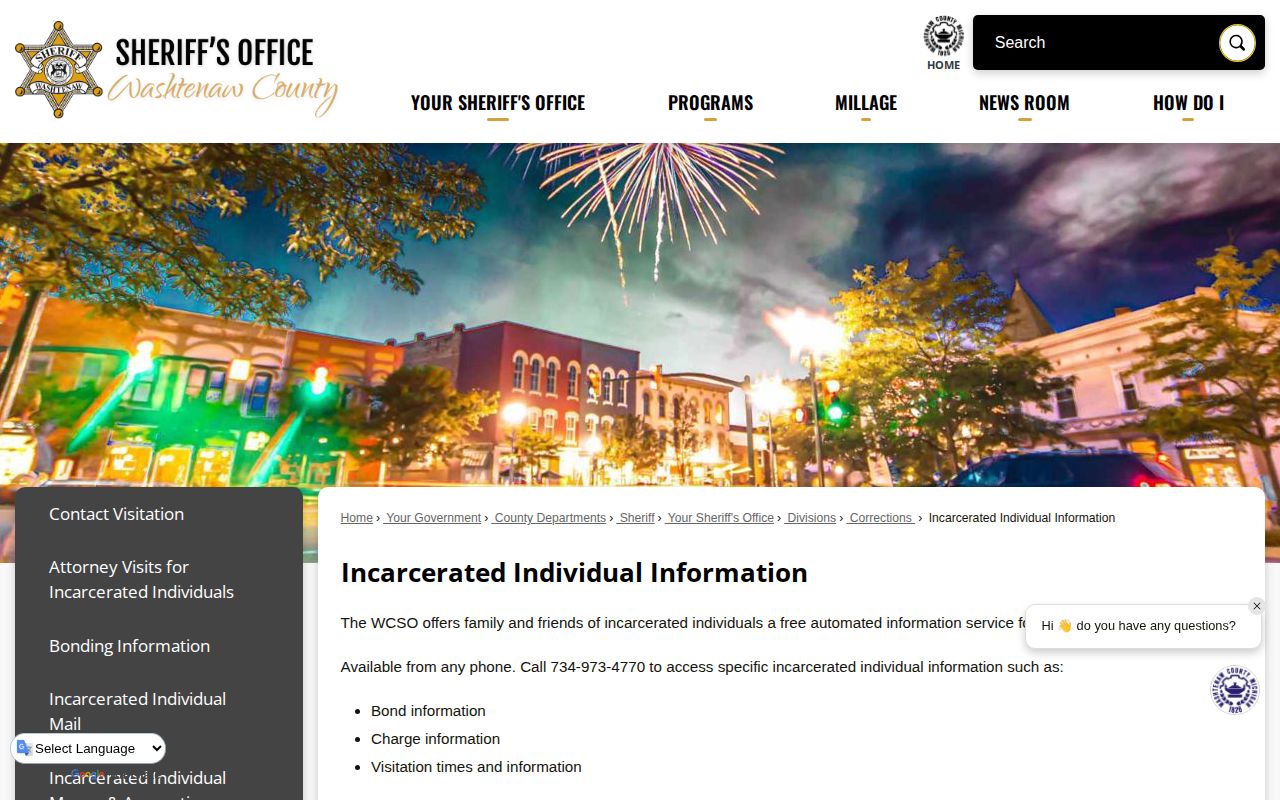
The menu helps route jail-service questions, but it does not publish names, release times, photos, or a rolling archive.
Washtenaw Release Systems Compared
A wider window increases the risk of mixing agencies. The county jail handles local custody. MDOC handles state prisoners and felony supervision. Federal imprisonment belongs to the Bureau of Prisons. Immigration detention belongs to ICE. A person can leave one system and enter another during the same three-day interval.
| Last known custody | Primary public path | Meaning of a release result |
|---|---|---|
| Washtenaw County Jail | WCSO record, MI-VINE, court case | Ends WCSO physical custody; destination must still be checked. |
| Michigan state prison | OTIS | Parolee means prison exit with MDOC supervision; Discharged means MDOC jurisdiction ended. |
| Federal prison | BOP Inmate Locator | Addresses BOP custody and date, not a Michigan jail event. |
| Immigration custody | ICE ODLS | Addresses ICE detention and some recent ICE releases, not ordinary county release. |
OTIS should not be used for a jail-only booking. Its public profile can show a state Parolee or Discharged status, but a missing OTIS record says nothing conclusive about WCSO custody. The BOP locator and ICE ODLS have the same sovereign limits.
Why Washtenaw Release Data Vanishes
The Washtenaw roster quirk is the absence of a verified public source, not a proven three-day deletion policy. WCSO's current menus show no public inmate search. The plausible former search address returns Page Not Found. As a result, no one can reliably infer that a name disappeared at a given hour, remained visible for a fixed span, or moved from an in-custody list into a release list.
The same lack of public presentation leaves cadence and retention unknown. It also means there is no official photo field to interpret. A missing name might reflect transfer, a spelling variation, restricted data, or the fact that no public list exists. Only the court, MI-VINE event, jail contact, and existing agency records can resolve those possibilities.
For an older MDOC matter, OTIS has its own limit. Public information normally remains for three years after the most recent discharge. A no-result after that window is not proof that no state case existed. Court records and an MDOC records request are the older-record fallback. The Washtenaw County released-inmate search maps those person-specific routes.