
Washtenaw Scheduled and Actual Release
Michigan prison records do not provide one universal “projected release date.” OTIS uses two different labels. Earliest Release Date is the point when Michigan Parole Board jurisdiction can begin under the sentence and applicable credit rules. Maximum Discharge Date is the possible outside date of the state sentence. A person may leave prison on parole after a grant and processing, remain confined after the earliest date, or reach the maximum and discharge.
County custody works differently. A pretrial detainee at Washtenaw County Jail has no computed prison date. Release may follow a posted bond, dismissal, time-served ruling, plea, transfer order, or another court event. Even then, the order date and actual book-out time may differ. A locally sentenced jail term must be read from the judgment, jail-credit language, and WCSO record, not calculated from an OTIS field.
Federal Correctional Institution Milan presents another distinct route. The BOP locator and federal judgment govern a federal term. Michigan OTIS does not calculate it. Leaving secure federal custody for a residential reentry setting or home confinement also may occur before the federal sentence ends.
Find a Washtenaw Inmate Release Date
Start with the last confirmed custodian. Washtenaw County contains the county jail, the state-run Women's Huron Valley Correctional Facility, and nearby FCI Milan. A result from the wrong sovereign can look like a missing record even when the person remains confined elsewhere.
- Identify the case type and last facility. Use WCSO and the Washtenaw court for a local jail case, OTIS for an MDOC sentence, and BOP for a federal sentence.
- For MDOC custody, open the OTIS offender search. Search by MDOC number when possible, or compare name results with date of birth and sentencing details.
- Read Current Status, Assigned Location, Earliest Release Date, Maximum Discharge Date or Discharge Date, and each sentence row. Concurrent or consecutive terms can carry different dates.
- For Washtenaw County Jail, review the Washtenaw Trial Court path for bond, sentence, jail credit, dismissal, or transfer entries. Ask WCSO for the actual release record when a completed timestamp is needed.
- Check for another hold, transfer destination, or court order. “Released from WCSO” can mean handoff to MDOC, another jail, USMS, or ICE.
- Confirm a reported custody event with the source agency. A data feed can lag, and a court order does not prove the precise moment release processing ended.
The Washtenaw County released-inmate record path is useful when the person has already left a roster and the goal is to identify where custody went next. For future timing, the sentence record and agency status carry more weight than a name disappearing online.
Note: An OTIS no-result cannot establish a county-jail release because ordinary jail-only custody falls outside the state prison database.
Washtenaw OTIS Release Date Fields
OTIS covers current and former MDOC prisoners, parolees, state probationers, and other listed state statuses. It does not cover each person booked in Washtenaw County. A profile can display sentence dates, current status, assigned location, offense data, and discharge details. The distinction between the profile header and a sentence row is important when more than one sentence is active.
| OTIS field | What it means | What it does not prove |
|---|---|---|
| Earliest Release Date | Earliest point for Parole Board jurisdiction under applicable rules | A guaranteed gate-out date |
| Maximum Discharge Date | Potential outside date of the MDOC sentence | That confinement must continue to that date |
| Current Status: Prisoner | Person remains in state-prison custody | Where each future placement will occur |
| Current Status: Parolee | Person left prison but remains in MDOC legal custody | End of the sentence or supervision |
| Current Status: Discharged | MDOC jurisdiction ended within the public record window | The exact county-jail book-out time |
| Assigned Location | Responsible institution or supervision office | The person's home address |
The official About OTIS explanation describes coverage, date fields, the public post-discharge window, and the need to verify corrections data. This captured view documents those system rules rather than a personal release promise.
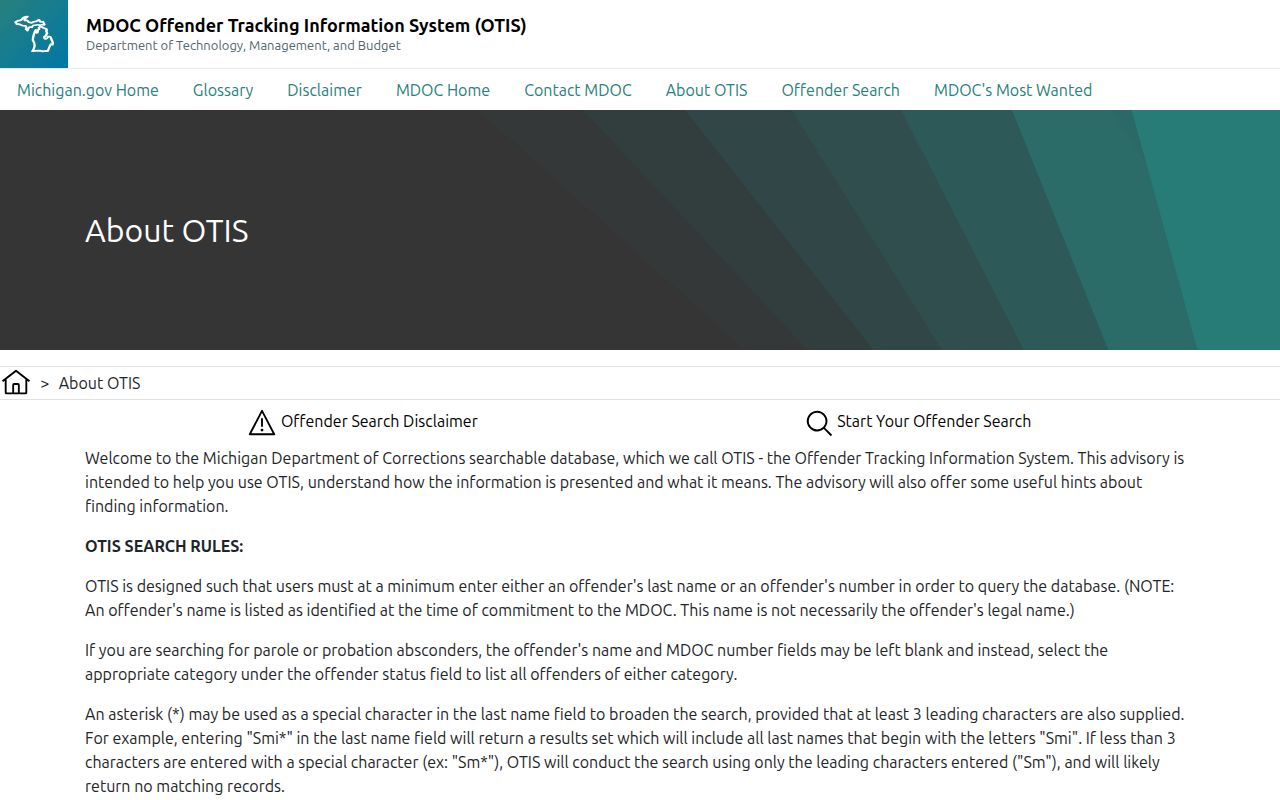
Because OTIS data can lag, a date that affects immediate plans should be checked with MDOC or the assigned institution.
Michigan Truth in Sentencing Dates
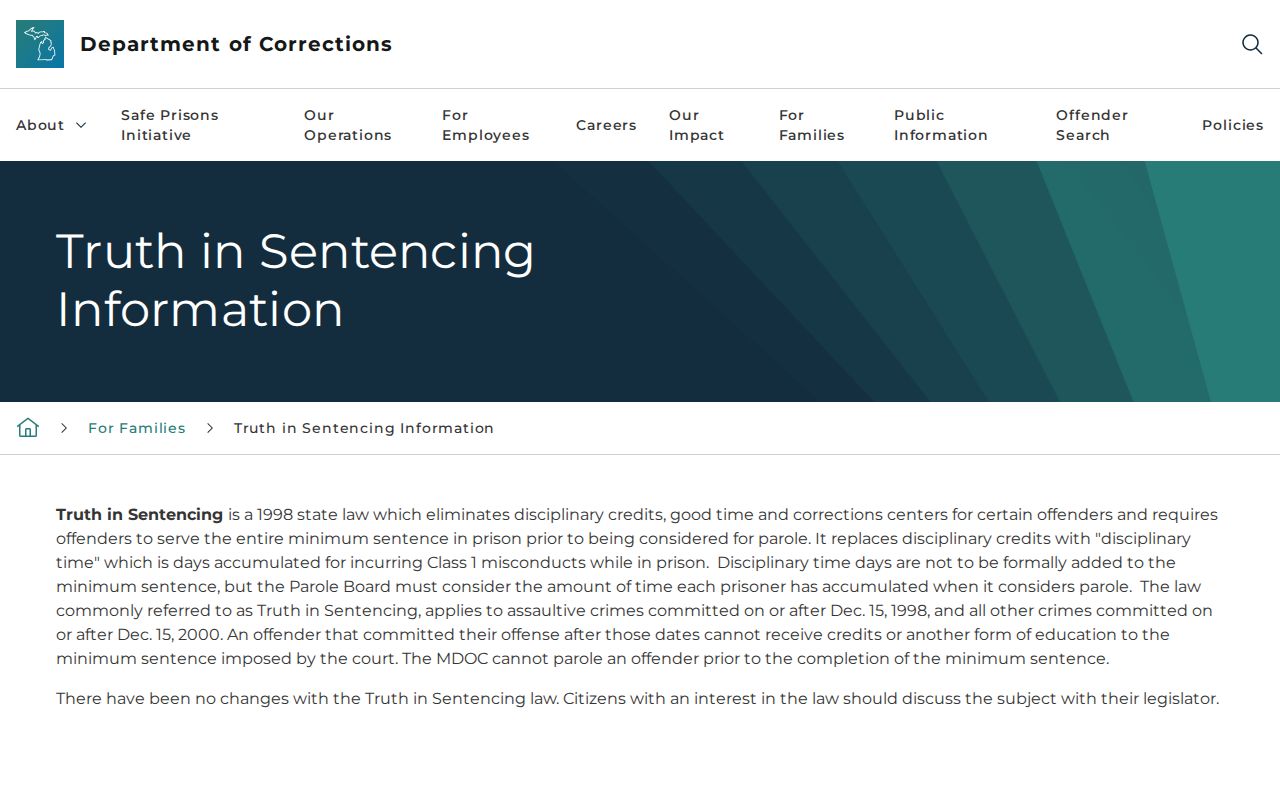
Michigan uses indeterminate sentencing for most prison cases. The judge sets a minimum and maximum term within the law. For specified assaultive offenses committed on or after December 15, 1998, and other covered offenses committed on or after December 15, 2000, truth in sentencing requires full service of the judicial minimum in prison before parole consideration. Older good-time or disciplinary credits do not shorten that minimum in covered cases.
Michigan does not have a universal rule that every prisoner serves 85 percent. That shorthand belongs to other sentencing frameworks and can give a false Washtenaw County release estimate. The accurate inquiry is whether the particular sentence falls under Michigan truth in sentencing, what the minimum and maximum terms are, and when the Parole Board gains jurisdiction.
MDOC's truth-in-sentencing explanation sets out the offense-date distinction. The manifest capture shows the official source used for the Washtenaw County inmate release-date analysis.
Apply that rule to the actual offense and sentence, not to a rough percentage or a date copied from another case.
Older Washtenaw Sentence Credits
Older pre-truth-in-sentencing terms can involve good time or disciplinary credits based on the offense date and governing statute. The MDOC glossary describes a historic disciplinary-credit scheme for crimes after April 1, 1987, but before the applicable truth-in-sentencing cutoff. It lists five days per month plus as many as two more days for especially good conduct, capped at 84 days per year, with potential loss for major misconduct.
That formula must not be applied to a modern sentence. It also should not be used without confirming the specific offense date, sentence structure, misconduct history, and MDOC calculation. Consecutive sentences can change when Board jurisdiction begins. Court corrections or amended judgments can alter the dates that MDOC receives. The official profile is a clue to the agency's current calculation, not a substitute for the underlying judgment.
For a Washtenaw County Jail sentence, no verified public WCSO good-time calculation policy was found. State-prison credit rules cannot be imported into a local sentence. The correct sources are the judgment, its jail-credit terms, the court clerk, and the WCSO release record. No verified county weekend-release rule was located either.
Why Washtenaw Release Dates Change
A date can move even when the sentence itself is valid. Michigan parole review generally begins before eligibility, and MDOC says release processing needs time after a favorable decision. A decision, parole date, and physical departure therefore should not be collapsed into one event.
| Factor | Possible effect on the date | Where to verify |
|---|---|---|
| Parole grant, denial, or deferral | Release may occur in the lawful interval, or review may be moved later | OTIS, Parole Board records, and Parole Release Unit documents |
| Release processing | A favorable decision still requires notice, placement, and administrative work | MDOC or the assigned prison |
| Consecutive sentences | Terms may aggregate and shift Board jurisdiction | Judgment, OTIS sentence rows, and MDOC |
| Misconduct or disciplinary rules | Older credits may be lost, or misconduct may affect Board review | MDOC sentence and disciplinary records |
| Detainer or other hold | Departure from one facility may become a transfer rather than community release | Releasing agency and receiving authority |
| Sentence correction or court order | Minimum, maximum, credit, or custody directions may change | Sentencing court and updated corrections record |
| Placement arrangements | Release processing may wait for an approved plan | MDOC and assigned supervision office |
For a county-jail case, bond, dismissal, time served, a new warrant, or a transfer order can change the practical answer with little warning. The court explains the authority. WCSO supplies the actual release or movement record. If another agency takes custody, the receiving agency becomes the next source.
Note: A detainer can end custody at one facility while preventing a return to the community, so destination is essential.
Washtenaw County and State Dates
Washtenaw County Jail holds people awaiting court action, serving some local terms, or waiting for transfer. A pretrial date is driven by the court, not by a sentence-credit formula. A person may remain confined until bond is posted or a judge changes the custody order. If the court commits the person to MDOC, the next useful date may appear only after state intake and calculation.
Women's Huron Valley is a state prison in Washtenaw County, not a county women's jail. A person leaving WHV on parole changes from prison confinement to supervised community placement while remaining in MDOC legal custody. A maximum discharge is different because it ends state jurisdiction. The physical location within Washtenaw County does not turn that state process into a WCSO release.
FCI Milan remains federal. Its release date belongs in the BOP Inmate Locator and federal case. A move to home confinement or a residential reentry center can occur while the sentence continues. Federal supervised release begins after imprisonment and is controlled by the federal court, not the Michigan Parole Board.
Confirm a Washtenaw Release Event
A future date should be paired with event notice, but an alert is not the sentence calculation. MI-VINE can track a selected participating county or MDOC record and send notice for reported custody changes. A phone registration uses a four-digit PIN, while text and email notices do not use that phone PIN. The detailed Washtenaw VINELink release-check process explains how to match the correct record and register.
When an alert arrives, identify the reporting agency. Confirm a county-jail release with WCSO and the court, a state-prison event with MDOC and OTIS, and a federal event with BOP. A reported release may instead describe a transfer, a move from prison to parole, or the end of one agency's physical custody. The release type and destination give the date its meaning.
For a written Washtenaw County timestamp, use the WCSO records-request route and name the booking and release sheet with the person's identifiers and case or booking number. Ask for actual release date and time, release authority or disposition, and receiving agency if the departure was a transfer. The county's incarcerated-individual information hub is useful for current jail services, but it is not a projected-date calculator.