
Washtenaw County Release Meaning
Release is an event, not one fixed legal status. A person can leave the Washtenaw County Jail after bond, dismissal, time served, or another court order. Yet the court case may remain open. Someone may also leave the jail through a transfer to the Michigan Department of Corrections, another county, federal custody, or an immigration authority. That person has left WCSO custody but has not entered the community. The destination and receiving authority matter as much as the release time.
Discharge has a narrower role in state corrections records. A person paroled from a Michigan prison is out of the prison but remains in MDOC legal custody under supervision. A maximum discharge, or a later discharge after parole, marks the end of MDOC jurisdiction. Federal supervised release is different again. It starts after imprisonment and is managed through the federal court system, not Michigan parole. A death may close a custody record, but it must not be treated as an ordinary release.
Washtenaw County Release Types
The release code or court order points to the next record. WCSO has not published a public field dictionary, so a code on a booking or movement record may need its existing code key. These common terms describe very different outcomes:
| Release type | What it means | Best next record |
|---|---|---|
| Bond | Conditional release before the case ends | Court bond order, WCSO release sheet, MI-VINE |
| Time served | The local custodial term was credited as complete | Judgment, jail-credit entry, WCSO release time |
| Dismissal | The identified charge was dismissed | Full court register and release sheet |
| Transfer | Another agency took custody | Receiving-authority field, OTIS, BOP, USMS, or ICE |
| Parole | Physical prison release with MDOC supervision | OTIS status, parole record, assigned office |
| Probation | Court-ordered community supervision | Court order or the correct probation system |
One person can have more than one case or hold. A dismissal in one file does not clear a bond, sentence, or detainer in another. Compare the release authority with every active case number. If the record only says “released from WCSO,” ask whether the departure was into the community or to a named receiving agency.
Note: A booking photograph records intake and does not prove that the person is still confined or that a release occurred.
Washtenaw County Release Record Fields
A county booking and release sheet ties the departure event to the right arrest. Since WCSO exposes no public online schema, the request should name the fields needed to separate release from transfer. Full name and date of birth help identify the person, while a booking number and court case number reduce the risk of matching the wrong record.
| Field | What it shows |
|---|---|
| Booking number | The jail event tied to the arrest and release |
| Booking date and agency | When custody began and which agency booked the person |
| Charge and court file | The case connected to that booking |
| Actual release date and time | When WCSO completed the departure event |
| Release authority or disposition | Bond, court order, time served, dismissal, transfer, or another basis |
| Receiving authority | Whether MDOC, another jail, USMS, or ICE took custody |
| Hold or detainer | Another agency's claim on the person at departure |
| Booking photograph | The intake image associated with the named booking |
The court file answers a different question. Its register of actions may show arraignment, bond changes, dismissal, sentencing, jail credit, probation, or case closure. That can explain the legal basis for release. It often does not record the minute when jail staff completed release processing. The WCSO release sheet supplies that timestamp. MI-VINE may help with the status event, but a written release record remains the better source when the exact time or transfer destination matters.
Request Washtenaw County Release Records
Use the official WCSO records-request hub and sheriff FOIA route. Michigan FOIA applies to existing records. It does not require the sheriff to create a new list, calculate an answer, or explain a code when no explanatory record exists. A narrow request is easier to route and makes clear that a transfer record is also relevant.
- Identify the person by full name, date of birth, booking number, and case number when known.
- Give a narrow date range and request the booking sheet, release sheet, and jail movement or transfer entry.
- Name the actual release date and time, disposition, authority, receiving agency, and booking photograph as separate fields or records.
- Ask for electronic copies and a fee estimate before work exceeds an amount you choose.
- If a code lacks meaning, request the existing code table or key rather than asking staff to draft an explanation.
Under MCL 15.235, an agency generally responds within five business days by granting, denying, granting in part, or issuing a permitted extension notice. That is a response deadline, not always the delivery date. MCL 15.234 governs fees, which may include allowed labor and copying costs. The current WCSO fee schedule should be checked live because the research did not support a safe fixed quote.
Washtenaw County Sheriff's Office
2201 Hogback Road
Ann Arbor, MI 48105
734-971-8400
The sheriff FOIA instructions show the current submission route. The captured county records page below helps identify the official path before a request is sent.
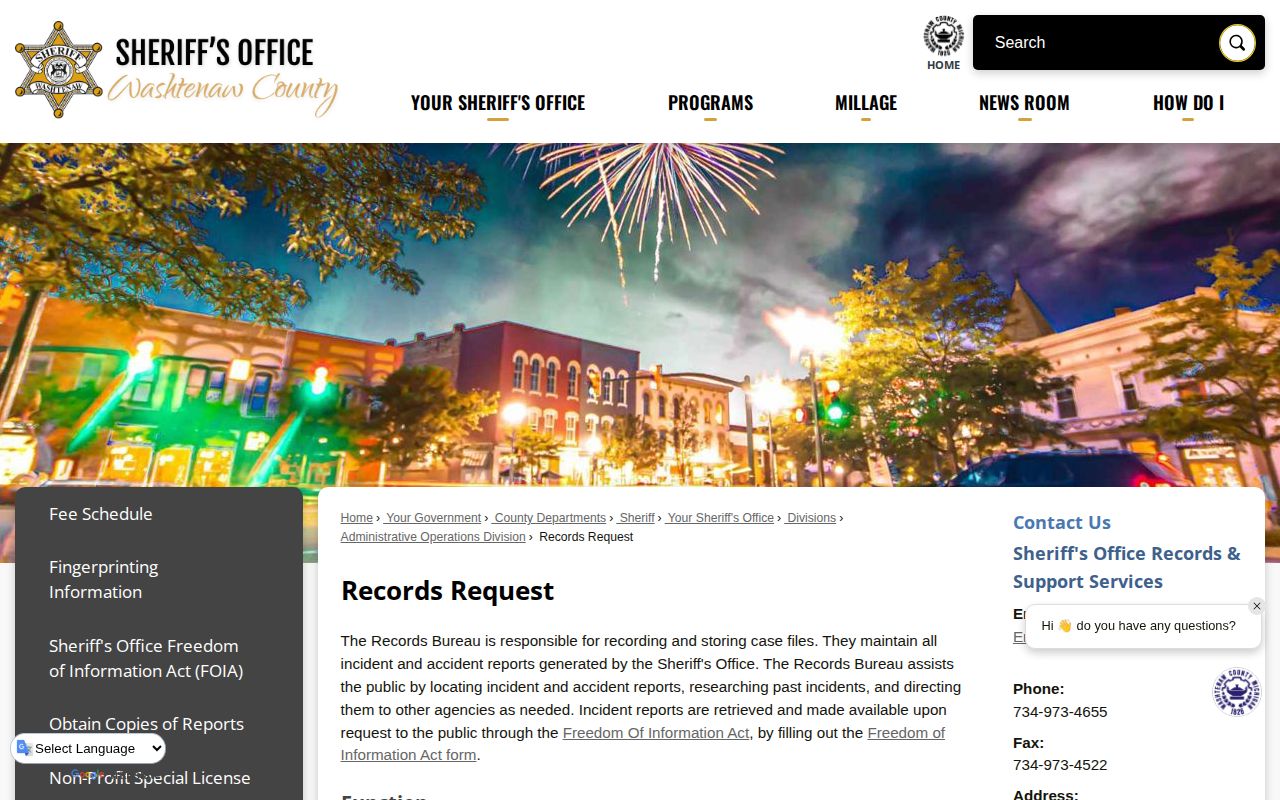
This official route is the fallback when no public roster or release archive provides the needed event record.
Washtenaw Release Records and FOIA
Michigan FOIA, MCL 15.231 et seq., favors access to nonexempt public-body records. MCL 15.233 addresses inspection and copies. Other parts govern fees, response steps, and exemptions. Privacy, active law-enforcement work, security, and records made confidential by another law can support withholding or redaction. Juvenile, medical, victim, sealed, and nonpublic details may receive added protection.
Michigan court records follow court rules, including MCR 8.119, rather than a simple assumption that all court files move through executive-branch FOIA. The clerk holding the accessible case file is the right source for a judgment, bond order, dismissal order, or probation-discharge order. Washtenaw criminal cases can pass among district and circuit courts, so the court named in the most recent register entry matters.
Set-Aside Washtenaw Release Records
Michigan set-aside law can make a conviction nonpublic in ordinary systems. A set-aside does not mean that each government datum or historical copy is physically erased. Under MCL 780.623 and MCR 8.119(H)(9), the protected conviction is nonpublic, and court staff generally cannot acknowledge it in a public response. In a case with more than one charge, protected material can be redacted while other public parts remain.
OTIS normally keeps a discharged MDOC profile public for three years after the most recent discharge. It may remove or update a profile sooner after court confirmation of a set-aside or other operation of law. An old no-result can therefore reflect the OTIS time limit, an excluded record, or a set-aside. It does not prove that no custody record ever existed. County booking, court, and MDOC retention rules are separate.
- Release
- Physical departure from a facility or an agency's custody.
- Discharge
- The end of the identified agency's sentence or supervision jurisdiction.
- Parole
- Prison release into MDOC supervision while legal custody continues.
- Time served
- A custodial term treated as complete through credited time.
- Set-aside
- A court action that makes a qualifying conviction nonpublic under Michigan law.
Note: When an official result disappears, check the court custodian and retention rules before drawing a conclusion about the person.
How Washtenaw Jail Release Worked
A 2003 Washtenaw jail planning assessment described Intake, Transfer and Release staff checking identity and eligibility, returning clothing and valuables, obtaining signatures, and directing released people through the public lobby. That source gives useful local history. It is not a current operating policy, and no current release hour, public exit, or family waiting rule was verified.
The distinction matters when arranging a pickup. A court order or VINE event does not state that every final identity check, property step, signature, and transfer check is complete. Call WCSO through its official line for current instructions. Do not rely on the historical lobby description as a promise about where or when a person will emerge today.
Washtenaw Bond Release Conditions
Bond ends physical jail custody only when the court and jail complete the required steps. It does not discharge the criminal case. Washtenaw's official jail information explains local accounting for a 10% bond: the court retains 10% of the posted amount, and the balance can be released to the bonder when the case ends or earlier by court order. The bond record and court register should be read together.
Post-bond controls may continue through a separate agency. The county Pre-Trial Program describes court-referred DART testing, supervised intensive treatment through Dawn Farm, and electronic monitoring. Those measures show that the person is outside the jail under conditions. They do not show that the charge or sentence is finished. The controlling court order identifies the terms.
Washtenaw Release Property Pickup
Property can be released before the person's own departure. WCSO requires the incarcerated person to send a kite, which is an internal written request, to Intake, Transfer and Release. The kite must name the person allowed to collect the property. The county warns that it should not be handed to a visiting officer.
The official WCSO property release procedure is the source for current instructions. Its captured page shows the local process.
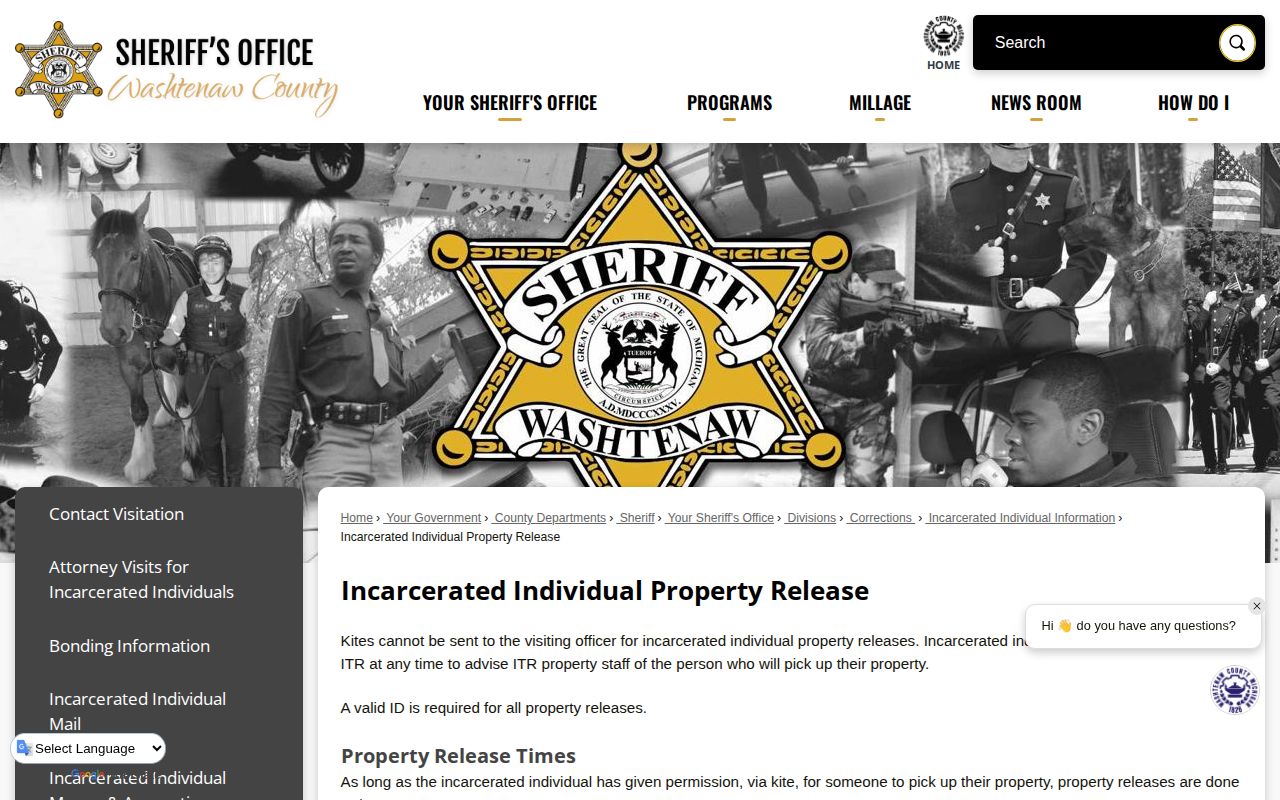
This advance-property process is separate from release confirmation. A completed pickup does not prove that the person has left custody.
Find Washtenaw County Released Inmates
Start with the last known custody system. Washtenaw County Jail cases use the county path. Michigan prison or MDOC supervision cases use OTIS. FCI Milan and federal cases use the BOP locator and federal court record. Immigration detention after a local departure uses ICE. Searching the wrong system creates a false no-result.
- Search MiCOURT and the right Washtenaw court by name or case number. Note bond, dismissal, sentence, time served, or transfer entries.
- Search MI-VINE by name and booking or offender number. Treat an event as a lead and confirm key facts with its source agency.
- Call WCSO at 734-971-8400 and ask for the jail or records channel. Provide stable identifiers when permitted.
- Request the booking and release sheet when a written time, authority, or receiving agency is needed.
- If the court shows a prison commitment, use OTIS. For federal or immigration custody, switch to BOP, USMS, or ICE.
An older no-result needs more work. OTIS may no longer display a person after its three-year post-discharge window. A jail-only booking never belonged in OTIS. A court file may be nonpublic, migrated, old, or set aside. Compare date of birth, official number, court file, sentencing county, and offense date before accepting a match.
OTIS Washtenaw Release Search
The Michigan Offender Tracking Information System covers current and former MDOC prisoners, parolees, MDOC probationers, interstate supervision, escapees, and absconders. It does not cover a routine Washtenaw County Jail stay, a local jail sentence, or a person not sentenced into MDOC. An OTIS miss is not proof of county release.
| Search field | Use | Notes |
|---|---|---|
| MDOC number | Best exact search | Prefer it when known |
| Last and first name | Broad identity search | Try name variations |
| Sex, race, age | Narrow results | Compare with other stable details |
| Offender status | Find Parolees or Discharged | Use All when the status is uncertain |
| Marks, scars, tattoos | Additional filter | Do not use alone as proof of identity |
Open the profile and read Current Status, Assigned Location, Earliest Release Date, Maximum Discharge Date or Discharge Date, and each sentence row. “Parolee” means the person left prison but remains under MDOC supervision. “Discharged” means MDOC jurisdiction ended. Earliest Release Date is a Board jurisdiction date, not a guaranteed departure appointment.
The official OTIS search screen shows the filters available for a Washtenaw County released inmate lookup.
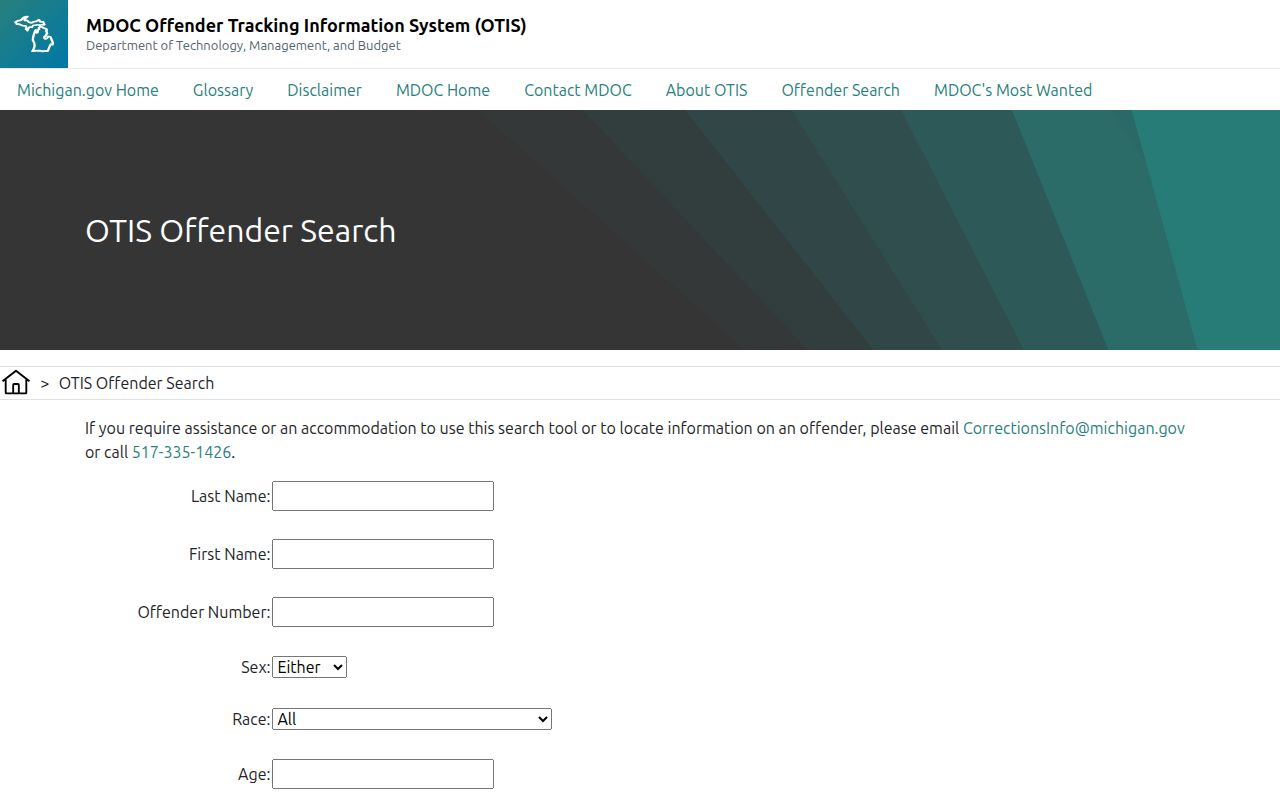
Use Discharged, Parolees, or All based on what is known, then verify the profile against the court case and MDOC record.
When an older or more detailed MDOC release record is needed, use the MDOC FOIA process. A focused request can name the discharge certificate, parole order, release-date record, or photograph. Past-prisoner records up to six years after release may route through MDOC records staff, while older material may require records retention or the Archives of Michigan.
Washtenaw County Recent Releases
WCSO does not publish a verified current inmate roster, recent-release search, 24-hour list, or 72-hour list. Its Corrections and Incarcerated Individual Information menus provide service links, but no public release feed. A plausible former inmate-search address now leads to an official Page Not Found. No public window, field list, update rate, photo flag, or retention span can be claimed.
For a release believed to have occurred today, use MI-VINE, the court event, WCSO contact, and a targeted booking or release-sheet request. A weekend or multi-day search can ask for an existing date-bounded release log if WCSO maintains and can disclose one. FOIA does not require the sheriff to create a new 72-hour list. The dedicated Released Last 24 Hours page keeps that same-day fallback focused.
The official WCSO jail-information menu documents the current service-oriented web path.
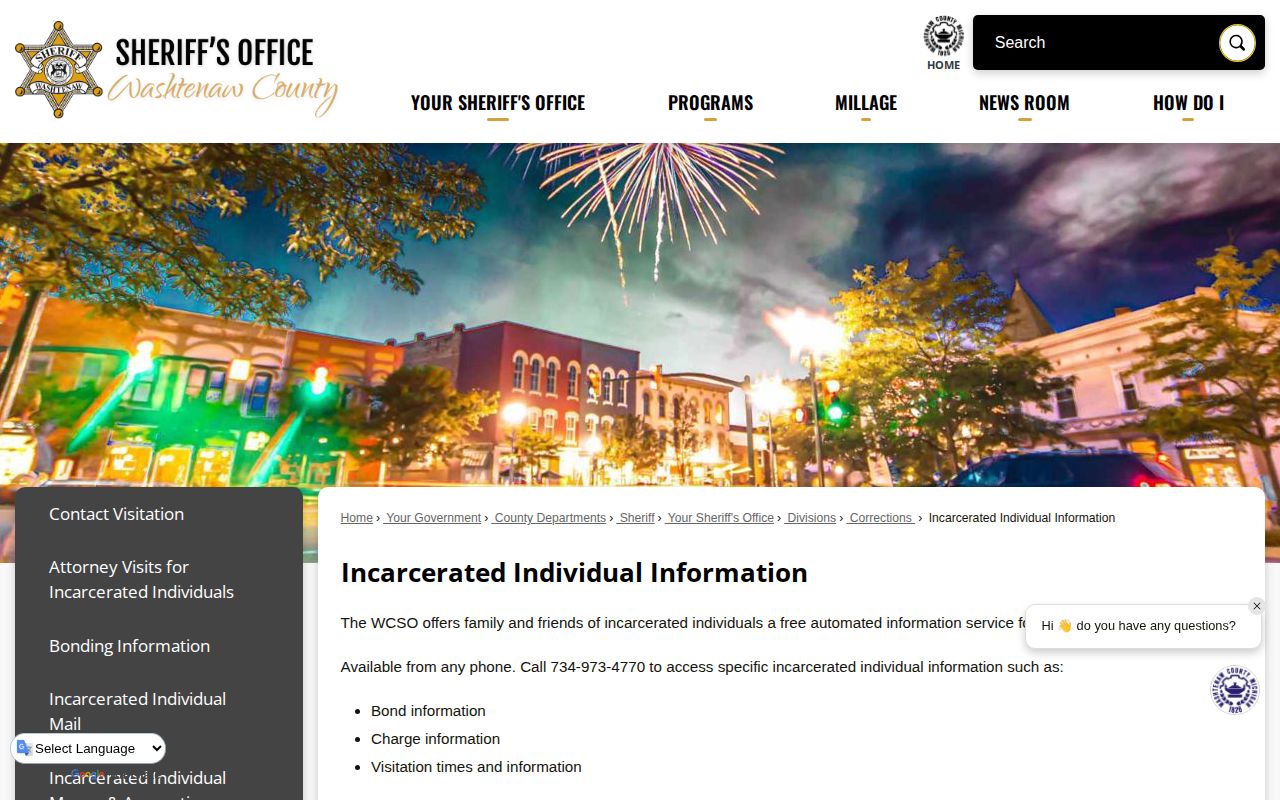
The absence of a public feed makes agency confirmation more useful than an unofficial roster carrying stale or unclear data.
Washtenaw Release Court Paths
Washtenaw has three community-control paths that are easy to confuse. A 14A District Court probation order covers local district-court supervision. Community Corrections manages pretrial programs such as tether or DART. MDOC parole and felony probation belong to the state system and can appear in OTIS. Being outside jail under any one of them does not mean the same office has the record.
Use the order to identify the agency. The 14A probation resource covers local supervision, while OTIS Assigned Location can point to an MDOC field office. Assigned Location is not the person's home. If a felony was bound from district court to circuit court on or after July 2, 2024, MCR 8.119(H)(10) can make the district record nonpublic while the accessible file moves to circuit court.
Note: A court release order explains legal authority, while the WCSO record supplies the actual jail-processing time and destination.
Washtenaw Release Transition Resources
Washtenaw transition work is built into several county systems. CSTS/JPORT provides continuity planning for incarcerated people receiving psychotropic medication. Jail classes include information about what to expect on parole or probation. Community Corrections runs local alternatives and controls. These services can help a person move from custody into care or supervision, but none is a public release-status record.
Release confirmation still comes from WCSO, MI-VINE, the court, or the receiving corrections agency. A program referral can continue after someone leaves the jail. It does not prove the exact gate-out time, show that all holds cleared, or establish that a sentence ended.
Washtenaw Release Notifications
MI-VINE through VINELink is Michigan's free custody and court-event notification service. It is available online, by mobile app, and by phone at 800-770-7657. Participating county jails send custody events, while MDOC provides general release notification for state prisoners. Search by name and add a booking or offender number when it is known. Review the agency and identity details before selecting a record.
Phone, text, and email notices can be tied to a matched person. Phone registration uses a four-digit PIN to acknowledge a call. VINE data can lag or miss a transfer between systems, so confirm a significant event with WCSO, MDOC, or the court. The Michigan Public Sex Offender Registry is a separate statutory registry. Presence or absence there is not proof of release.
Federal and ICE Release Checks
FCI Milan is federal, so WCSO and Michigan OTIS are not authoritative for its sentence. The BOP Inmate Locator covers federal prisoners and may show a released or not-in-BOP-custody result with a release date. A person can also leave secure prison for a residential reentry center or home confinement. Read the federal judgment to learn whether court-ordered supervised release follows imprisonment.
USMS defendants may be held in local contract space before a BOP record exists. There is no public USMS locator equal to BOP's tool. For immigration custody, ICE ODLS searches by A-number and country of birth or by exact biographical details. A WCSO transfer or detainer entry can mean immediate handoff, not community release. ICE says ODLS includes current detainees and some people released from ICE custody within the prior 60 days.
No stable evidence showed that WCSO runs an ICE detention contract facility. The safe sequence is to confirm the county departure record, identify the receiving authority, and then use that authority's official system.
Compare Washtenaw Release Systems
Each system answers a limited question. A current jail roster, if one existed, would show present custody. Washtenaw does not provide that public tool. The WCSO booking or release record documents the county event. OTIS tracks state corrections status. BOP covers federal custody. ICE covers immigration detention. The court explains the order and case result.
County jail: Call WCSO, check MI-VINE and court entries, then request the release sheet. Use it for actual time and transfer destination.
State prison: Search OTIS for Prisoner, Parolee, or Discharged. Read dates and sentence rows, then verify with MDOC when needed.
Federal custody: Use the BOP locator and federal case. A BOP release date does not explain later federal supervised release.
Immigration custody: Use ICE ODLS after a county transfer or hold points to ICE. Do not treat county departure as freedom in the community.
Why is a released person missing? The agency may remove active-custody data after departure, the name may vary, the person may have transferred, or a public retention period may have ended. Absence alone cannot choose among those outcomes.
Getting Home After Washtenaw Release
TheRide's Route 66 guide offers a transit planning lead for the County Service Center and Hogback Road area. The published guide shows service on limited weekday trips and no Sunday service. It does not establish a jail-door shuttle, a current release-time connection, or the safest waiting point.
Check the latest route and stop details with TheRide before planning travel. A person arranging a pickup should also seek current WCSO instructions because no present family-waiting or public-exit policy was verified. Court timing, final jail checks, and another agency's hold can all change the departure.
WHV Is a State Release
Women's Huron Valley Correctional Facility is Michigan's only prison for women. Its Ypsilanti campus combines statewide female reception, all security levels, Special Alternative Incarceration functions, reentry programs, and Washtenaw parole offices. Its location within the county does not turn a WHV departure into a WCSO jail release.
A woman paroled from WHV should be checked in OTIS for a move from Prisoner to Parolee and an assigned supervision location. Maximum discharge or completion of parole can later produce a Discharged status. MI-VINE may provide event notice. The WCSO release record and county recent-release paths do not control this state-prison event.
Washtenaw County Release Facilities
Four facilities create four distinct record paths. The operator and legal authority decide where the release must be verified.
- Washtenaw County Jail: WCSO record, court case, MI-VINE, and the receiving agency when transferred.
- Women's Huron Valley Correctional Facility: OTIS, MDOC records, and MI-VINE for a state release or discharge.
- Federal Correctional Institution Milan: BOP Inmate Locator and the federal case for custody and supervised-release context.
- Washtenaw County Youth Center: juvenile court, Children's Services, authorized family, and counsel under restricted-access rules.
A juvenile name should not be tested against adult tools to infer custody. Likewise, an OTIS no-result says little about a county-only jail stay, and a WCSO departure says nothing final about later federal or state custody.